
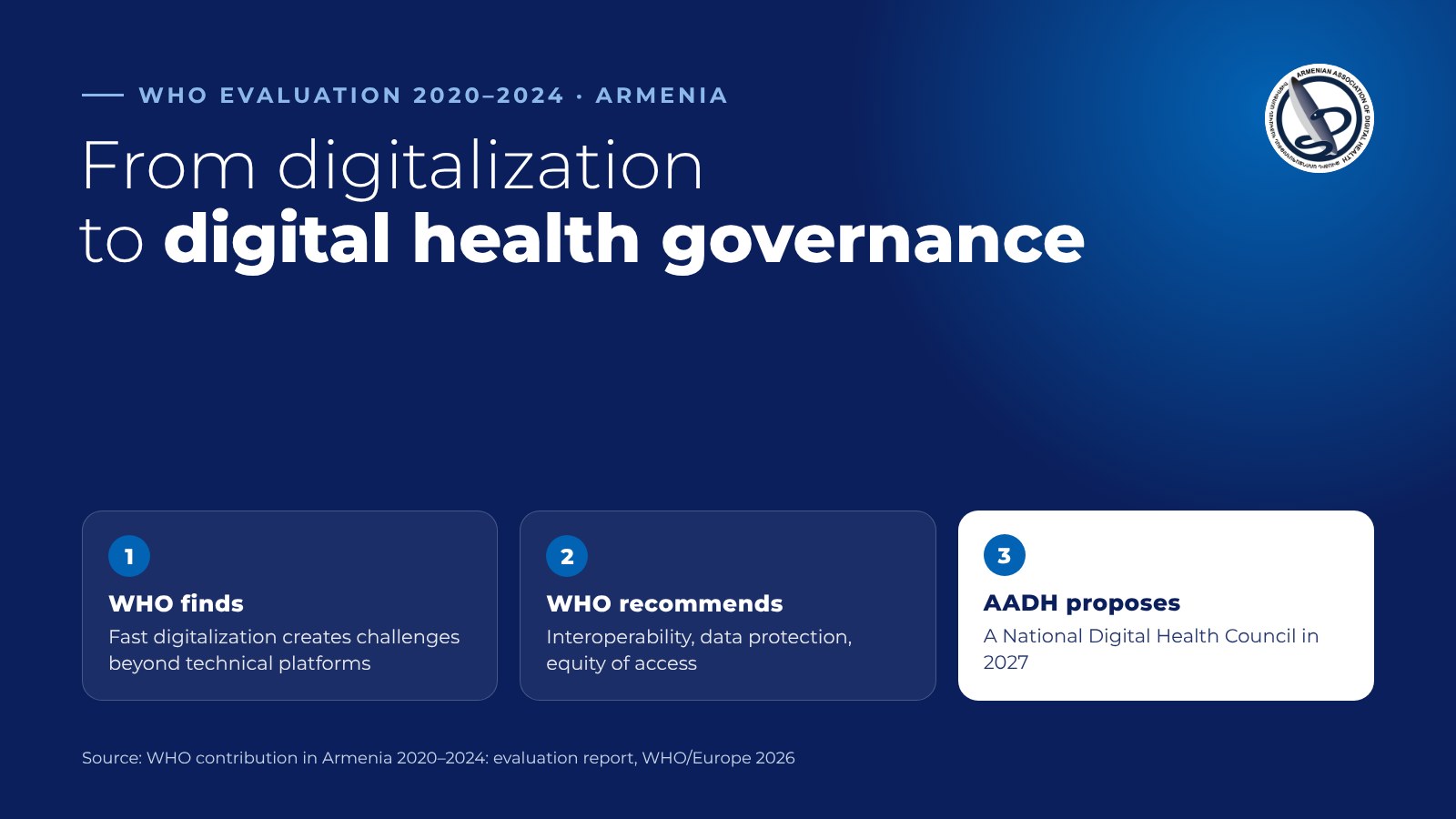
A new evaluation by the World Health Organization (WHO) Regional Office for Europe finds that Armenia’s digital health transformation has moved fast, and that governance now needs to catch up. Here is what the report says about digital health, what WHO recommends, and what the Armenian Association of Digital Health (AADH) proposes for 2027.
Key facts
- Report: WHO contribution in Armenia 2020–2024: evaluation report
- Publisher: WHO Regional Office for Europe, 2026 (document WHO/EURO:2026-13276-53050-82809)
- Scope: WHO’s cooperation with Armenia’s health sector from 2020 to 2024
- Digital health finding: fast digitalization has created challenges in governance, interoperability, data protection, digital literacy and equity of access
- AADH proposal: a National Digital Health Council in 2027
What WHO found: progress, and new governance challenges
The evaluation recognises real progress. Armenia expanded the ArMed national e-health platform and introduced mandatory e-prescriptions. According to the report, ArMed now connects public hospitals, clinics and pharmacies, and e-prescribing is mandated for 470 products, including all antibiotics and antivirals (p. 48).
But the report is equally clear that technology alone is not enough:
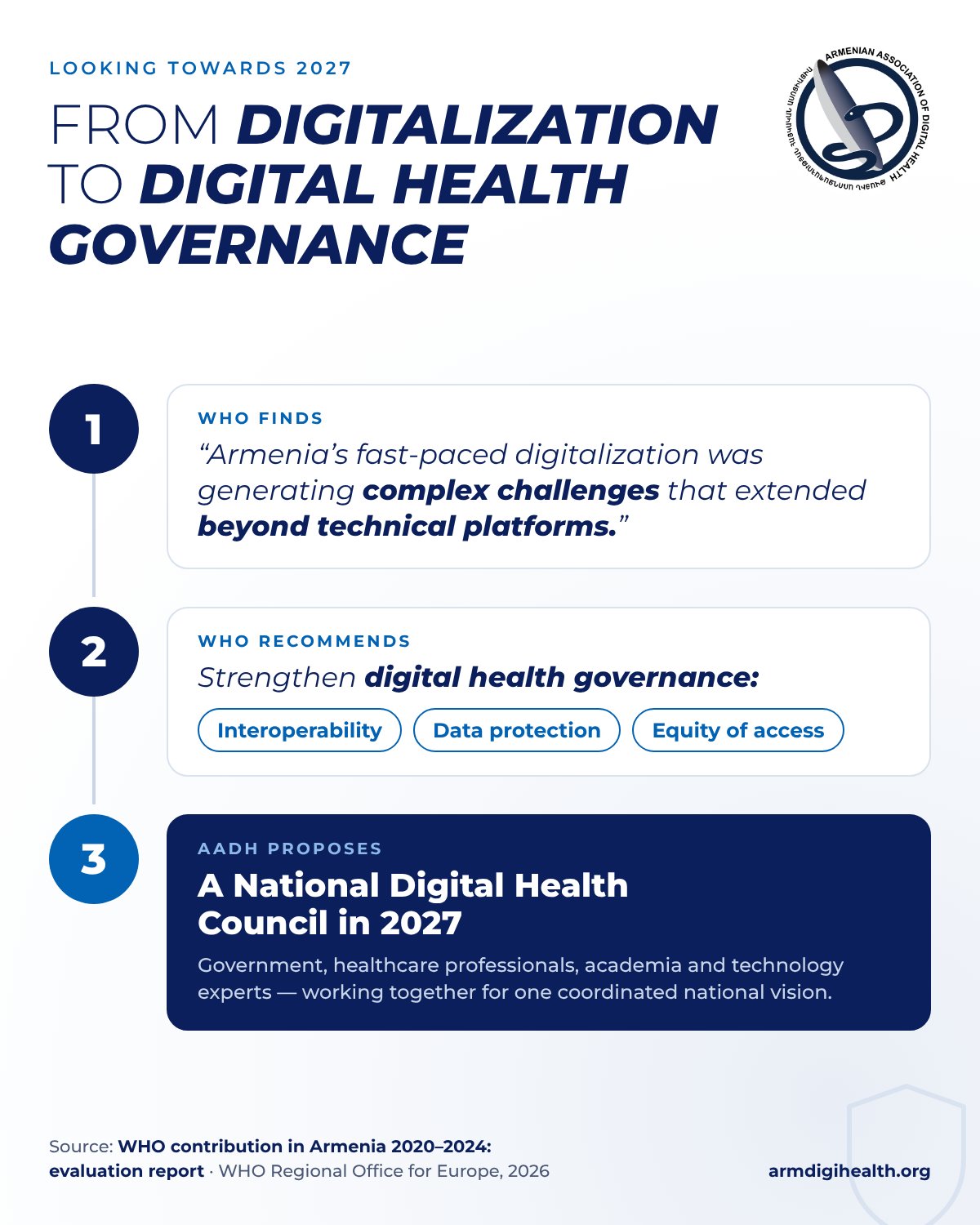
Armenia’s fast-paced digitalization was generating complex challenges that extended beyond technical platforms.
WHO contribution in Armenia 2020–2024: evaluation report, p. xi
Stakeholders interviewed for the evaluation raised concerns about governance and regulatory oversight, the adequacy of data protection frameworks, gaps in the digital literacy of the health workforce, and inequalities in access between urban and rural populations (p. xi). The executive summary lists the same pressure points: governance, interoperability, data protection, digital literacy and rural connectivity (p. vi).
What WHO recommends
- Anchor digital reforms in governance. WHO’s potential contribution will depend on helping ensure that digital reforms are anchored in regulation, inclusivity and health system resilience, rather than being driven solely by technology adoption (p. xii).
- Use a practical governance checklist. Complement the technical work on e-prescribing and ArMed with a checklist covering interoperability, privacy and ethics, and inclusive access, so that digitalization narrows rather than widens access gaps (p. xvi).
- Build government-led coordination. Stakeholders emphasised that Armenia would benefit from a government-led coordination mechanism with clear roles for each partner (p. xiii).
- Strengthen engagement on digital health governance. Stronger engagement will be needed so that reforms advance safe, inclusive and resilient digital transformation (p. 36).
What AADH proposes: a National Digital Health Council in 2027
AADH welcomes the evaluation and its focus on governance. Armenia has built strong digital foundations; the next step is a shared structure to steer them. We propose the creation of a National Digital Health Council in 2027, bringing together:
- government and public health institutions,
- healthcare professionals and their associations,
- academia and training programmes,
- technology experts and companies.
Working together, these actors can align priorities, set common rules for interoperability and data protection, and make sure digital health reaches every community in Armenia, in cities and in rural areas alike.
Frequently asked questions
What is the WHO evaluation report on Armenia?
WHO contribution in Armenia 2020–2024: evaluation report was published by the WHO Regional Office for Europe in 2026. It assesses the relevance, coherence, effectiveness, efficiency and sustainability of WHO’s support to Armenia’s health sector between 2020 and 2024, including digital health.
What is ArMed?
ArMed is Armenia’s national e-health platform. It includes e-prescribing and health records and connects public hospitals, clinics and pharmacies.
What does digital health governance mean?
Digital health governance is the set of rules, institutions and coordination mechanisms that steer how digital tools are used in health. It covers interoperability standards, data protection, ethics, digital skills and equitable access.
What is AADH proposing?
AADH proposes a National Digital Health Council in 2027, bringing together government, healthcare professionals, academia and technology experts around one coordinated national vision for digital health in Armenia.
Source: WHO Regional Office for Europe. WHO contribution in Armenia 2020–2024: evaluation report. Copenhagen: WHO Regional Office for Europe; 2026 (WHO/EURO:2026-13276-53050-82809). Licence: CC BY-NC-SA 3.0 IGO. Page numbers refer to the report. See also WHO Armenia publications.